Space and Form (2021)


Basic information:
- Role: Main Instructor, Course Designer
- Institution: Xianda College, Shanghai International Studies University, China.
- Term: Fall 2021
- Target Students: First-year undergraduate students majoring in Environmental Design.
- Course Details: Compulsory, 3 credits
- Logistics: 7 weeks (3 hours/week)
- Class Size: ~30 students
Overview
In this course, students learn to utilize formal language to guide the analysis, variation, and remixing of environmental design projects. The curriculum integrates case studies of real-world projects with incremental hands-on exercises to explore the following core concepts:
- Formal Elements: The identification and transformation of basic geometric forms.
- Spatial Definition: Strategies for utilizing form to define and delimit space.
- Spatial Organization: The logic of arranging formal and spatial components.
- Human Factors: The impact of form and space on human experience, including circulation, proportion, and scale.
By the end of the course, students will be able to intentionally apply formal and spatial strategies in their work. The goal is to prepare students for subsequent architectural design studios by fostering improved spatial awareness, clearer design logic, and increased confidence during the early conceptual design phase.
Target Audience
This compulsory course is designed for junior undergraduate students majoring in Environmental Design.
Before taking this course, students have already gained fundamental knowledge of shape composition, but more in a sculpture context rather than a built environment design context. After this course, students will take architecture design studios. Therefore, this course aims to bridge the gap between basic shape composition and architecture design.
Course Schedule
Week 1 – From Concrete to Abstract: Fundamentals of Formal Language
- Introduction and basic elements in design: points, lines, planes, and volumes. (30 mins)
- Transformation and composition of elements. (45 mins)
- In-class exercise: Pasta Taxonomy - Students cluster and categorize various pasta shapes based on formal characteristics to practice abstract categorization.
- Apply formal language to architecture design analysis. (45 mins)
- In-class exercise: Group analysis of formal languages in two selected architectural cases, followed by a presentation of findings.
- How formal language relates to human cognition and social context. (30 mins)
- Introduce Assignment 1: Variate
Week 2 – How forms define space
- Review Assignment 1. (45 mins)
- Spatial definition through form: methods and strengths. (45 mins)
- Architecture design project analysis. (45 mins)
- In-class exercise: Using a provided SketchUp model of a park design, students are instructed to vary its spatial definition methods. (45 mins)
Week 3 – Spatial Composition
- Spatial Relationships: Adjacent space, space within space, interlocking spaces.
- Spatial Organization: linear, clustered, radial, and grid compositions.
- Introduce Assignment 2: Reconstruct
Week 4 – Proportion, Scale, and Integrated Case Analysis
- Critique and review of Assignment 2. (45 mins)
- Proportion and scale in space, with two case studies. (45 mins)
- Introduce Final Assignment: Mix and tutoring. (45 mins)
Week 5 – Case Study Presentations & Design as Social Language
- Group presentations on case studies.
- Design as social language: expression of traffic and circulation elements.
- Studio Time: Development of the Final Project.
Week 6 – Final Project Guidance
- Studio Time: Desk crits and supervision of Final Project development.
Week 7 – Final Project Presentations & Critique
- Final presentations, jury critique, and class discussion.
Assessments & Grading
- Attendance (20%)
- Assignment 1: Variate (5%)
- Assignment 2: Reconstruct (15%)
- Final Project: Mix (60%)
VARIATE
Using the concepts of form and space introduced in today’s lecture and outlined in
Francis D.K. Ching’s Architecture: Form, Space, and Order, reinterpret a given precedent through a process of formal transformation.
Using dimensions such as basic geometry, formal transformation, formal operations, aggregation/composition, and primary–secondary relationships, select at least four parameters and carry out a sequential process of formal transformation. The process should culminate in a new formal outcome that demonstrates clear generative logic.
This assignment aims to develop an understanding of form-making as a generative process, emphasizing formal logic, transformation sequences, and spatial articulation as foundational tools in architectural design thinking.
Here is an assignment example: 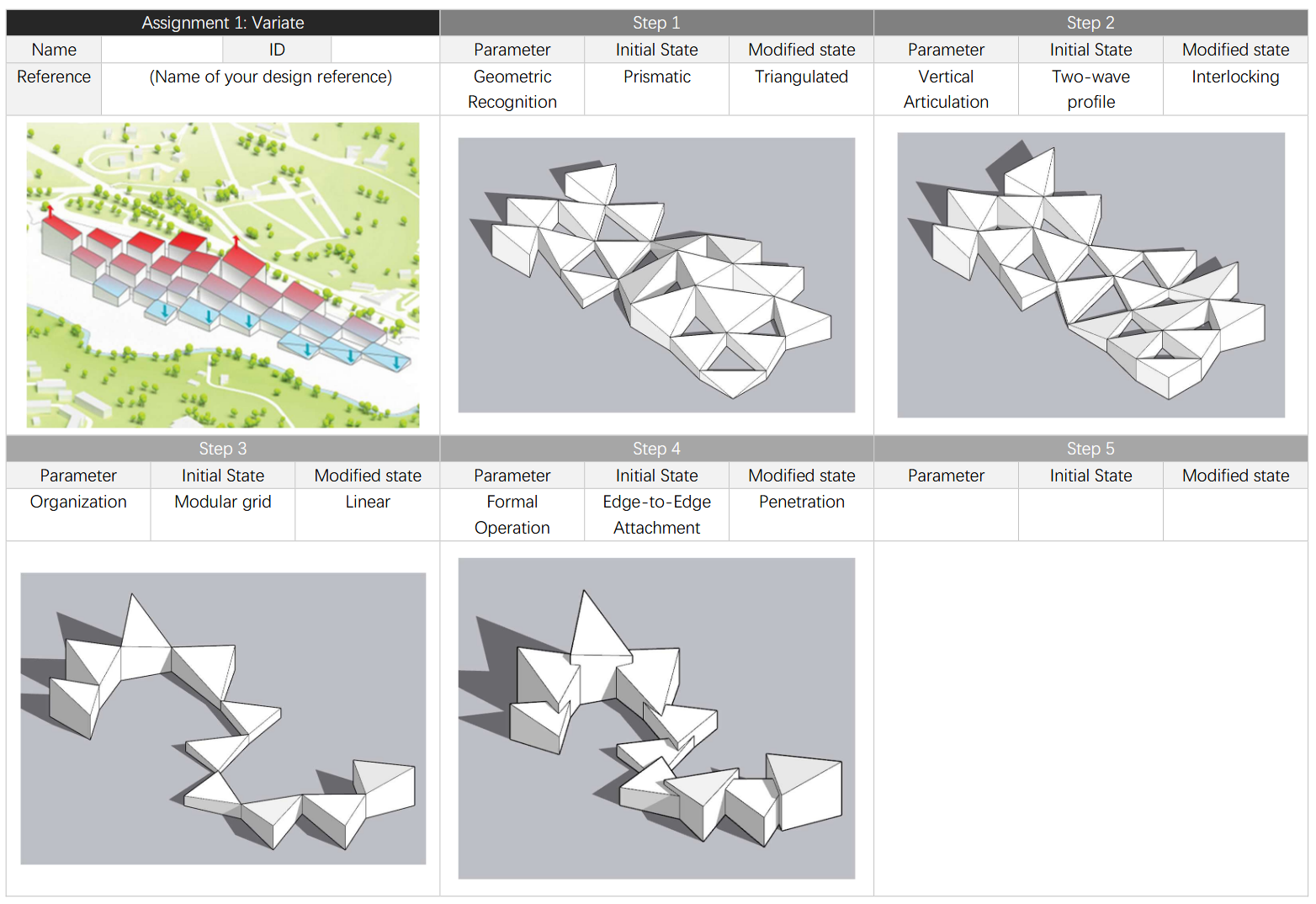
RECONSTRUCT
This assignment is divided into two sequential tasks.
You will begin with a plannar compositional study and then translate it into a three-dimensional spatial sequence.
Task 1: Color-Based Composition Through Sequence
Using the given base diagram, create a color composition based on sequential logic.
- The total colored area must exceed 75% of the total surface area
- Each color field (including white) should remain relatively simple and legible
- Prefer polygons with no more than five sides
- Introduce at least five color families
- Each color family may include variations in value or saturation
- The total number of colors should be 8–10
- Design a meandering path that visually and conceptually connects different color families
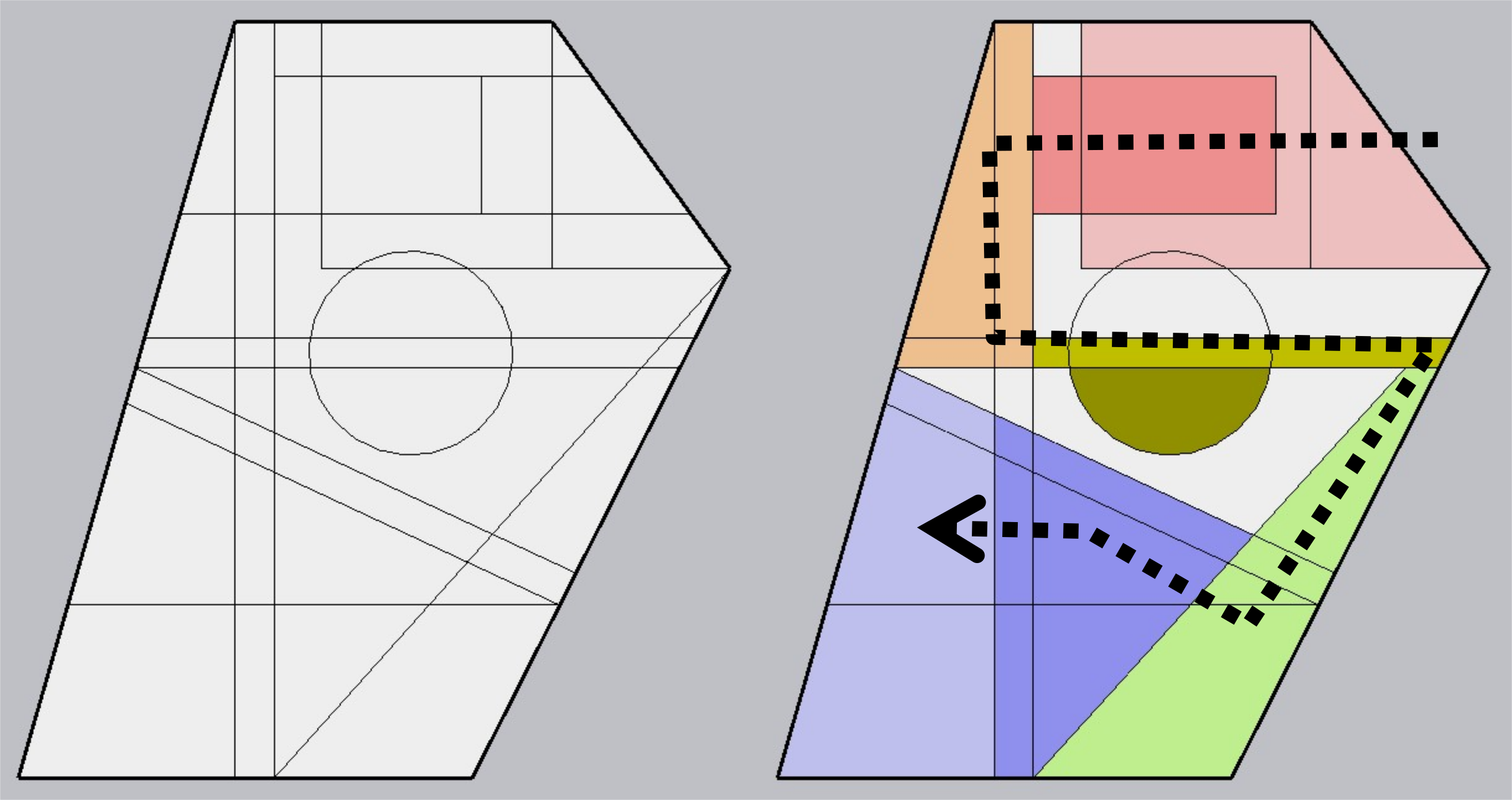
Task 2: Constructing a Spatial Sequence Through Color
Translate the color composition from Task 1 into a three-dimensional spatial model.
Use color as a primary tool to define and differentiate space.
- Darker colors should produce a stronger sense of spatial enclosure
- Spatial boundaries between blocks of the same color family should be weaker than those between different color families
- Adjacent white color fields should be interpreted as a continuous spatial volume, extended as a whole
- All architectural elements involved in defining space—including walls, ceilings, and planes—must be assigned the corresponding color of the space they define
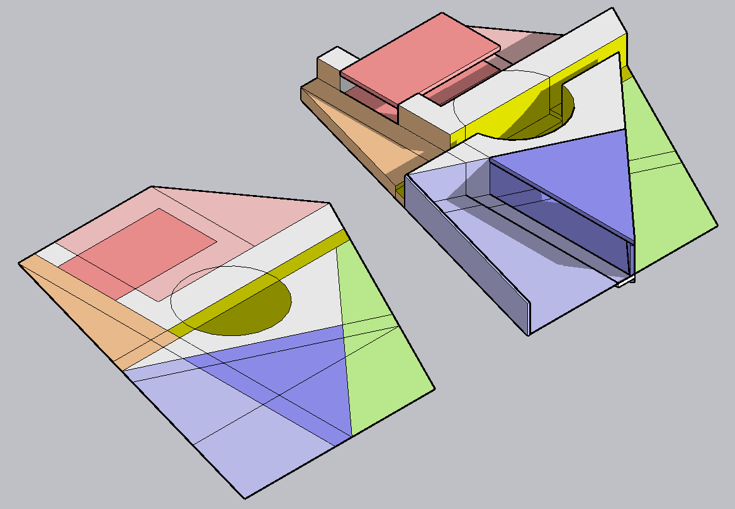
MIX
You will work in group of 2-3 to complete the following tasks.
Task 1: Case Study Presentation
- Comparative case analysis using learned theories.
- Analyze two design works of the same type.
Task 2: Formal Reorganization
- Based on the two case studies, select key formal/spatial characteristics that you find most interesting. Mix the selected characteristics into a new design project based on a given design brief.
Example outcomes: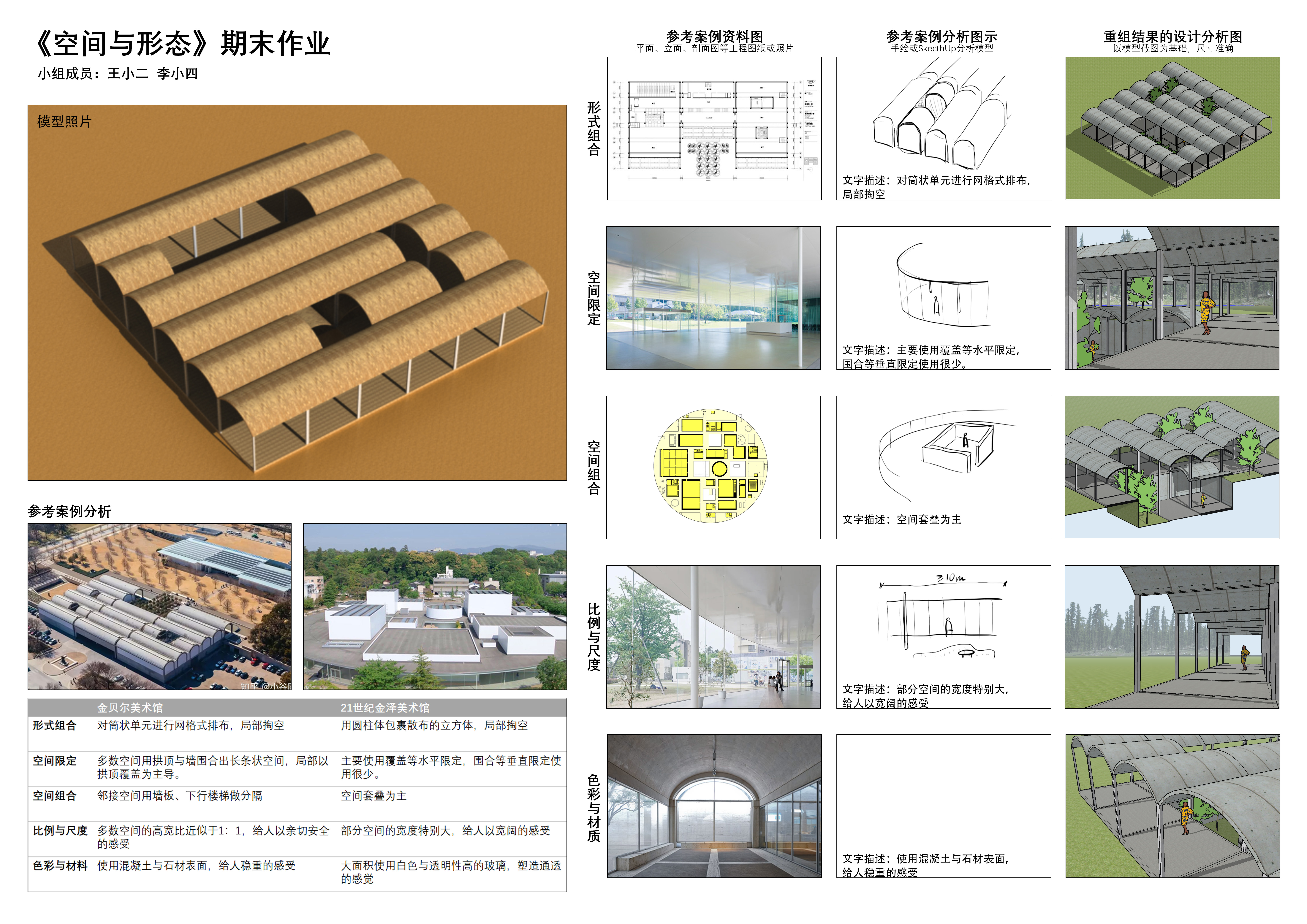
Reflection & Development
Maintain the Strategy of Highly Controlled Assignments
One of the primary challenges for junior undergraduates in design studios is the steep learning curve. The comprehensive nature of architectural design requires students to simultaneously master technical skills (software, physical model making) while managing complex conceptual factors (planar, volumetric, and spatial organization). These competing demands often scatter their focus, making it difficult to achieve significant depth or progress in any single area.
Although the broader curriculum follows a progressive structure (2D composition -> volumetric design -> spatial design -> architectural design), experience suggests this macro-progression is insufficient on its own. Within the course structure, we require more granular, targeted training. By "fixing" or constraining certain design variables, we allow students to focus their exploration on specific dimensions. This approach helps them better master:
- The diversity of design maneuvers available within a specific constraint.
- The direct correlation between a specific design move and its resulting spatial effect.
The structure of Assignment 1 and Assignment 2 was heavily influenced by this philosophy. Given the constrained timeframe (7 weeks, meeting only once a week), the students' progress was commendable compared to standard semester-long studios. Therefore, this pedagogical strategy should not only be retained but further emphasized in future iterations.
Further slow down the pace
There is still a significant conceptual leap from Assignment 2 to the Final Project. In the current iteration, students struggle as they need to abruptly transition from the highly constrained, process-oriented task of "translation" (Assignment 2) to the open-ended, synthesis-oriented task of "creation" (Final Project). This requires them to simultaneously manage abstract formal logic and concrete design briefs, which proved overwhelming without intermediate scaffolding.
Therefore, I plan to integrate the Final Project into an extended Assignment 2. Rather than starting from scratch, students will deepen their engagement with the "Reconstruct" phase through a case-guided approach:
Task 1: Comparative Case Study (Weeks 3–5)
- Activity: Students analyze these schemes to understand how color codes translate to spatial logic. This replaces the original open research task.
- Timeline: Presented Week 4 but submitted Week 5, leaving rooms for integrating lecturers' feedback.
Task 2: Guided Spatial Design (Weeks 5–7)
- Modification: Instead of finding their own coloring, the lecturer will provide 2–3 pre-colored schemes based on the base diagram. Students select one of the schemes to develop into a full 3D spatial design.
- Constraint: They are required to explicitly employ at least three specific design methods identified during their Case Study (Task 1).
- Timeline: Introduced Week 3; Tutoring Weeks 5–6; Final Critique Week 7.
Deeper integration with software teaching
Since many junior students enter this course without prior SketchUp proficiency, treating software learning as a separate burden is counterproductive.
Moving forward, software instruction should be contextualized within design theory. When explaining concepts of space and form, I will demonstrate how to implement these specific geometries and operations directly in SketchUp. This "concept-to-tool" approach ensures students associate software commands with design intent rather than just technical function.